Two Producers, One Synth, One Track: A Techno Masterclass With Jam El Mar
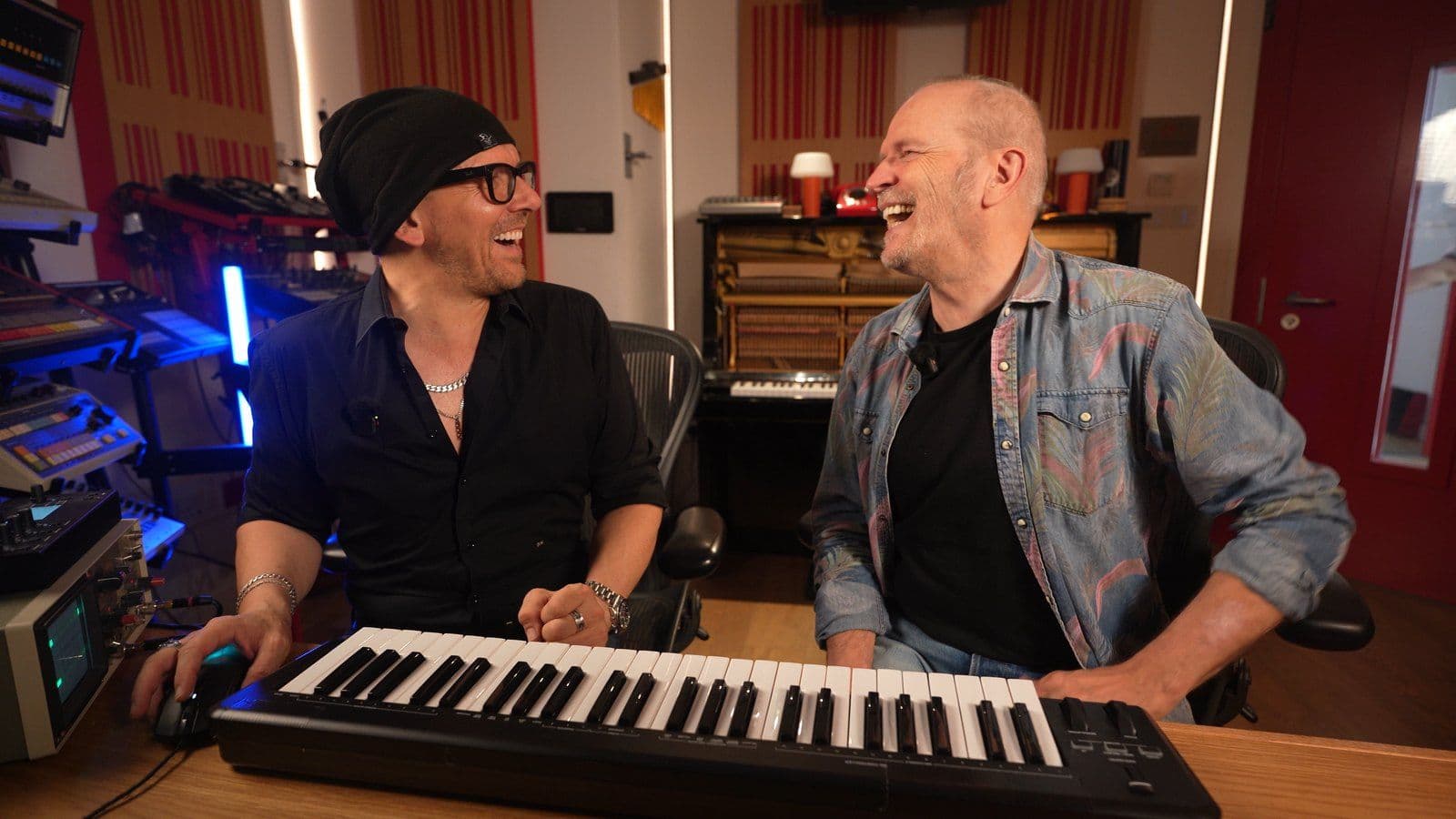
Jam El Mar came to the studio. One half of Jam & Spoon, one of the people who genuinely defined what German techno sounds like. We sat down and built a track together using nothing but one synth.
There's a lovely coincidence behind it. Martin at Martinic had asked us both to make presets for the Prodigy, separately, without either of us knowing the other had been asked. So we started the session by playing each other's patches — and ended up with an entire early-nineties techno arrangement made out of them.

What follows is less a product demo than a masterclass. I asked a lot of questions. He answered all of them.
The tempo map of dance music
I asked him for the range of techno and got a proper answer.
- Melodic techno sits around 125–128
- Mainstage techno goes up to about 138
- The hard, fast stuff goes to 160 or 170 — without breaking into half time
As a DJ he tends to play around 137. But for early-nineties, old-school techno, the number is 128 to 130. When he started making music, the Belgian records that were getting played in clubs were around 130.
For contrast, here's how I think about house. 120 is ten o'clock at night. Your cruising speed is 125–126. Push to 128 for something with a Latin feel — and past 128 it stops being house music.
We settled on 128, because the sound we had needed space to build.

Why your samples don't sound like house
This is the piece of information I've been chasing for years, and I want to draw a line under it.
I'm a classically trained pianist with a degree in orchestration, and I was fairly snobbish about DJs until I got schooled by people like Louie Vega and Dave Lee. What I could never work out was why a record would sound like house music immediately in their hands, and not in mine, when we were picking from the same samples.
Jam gave me the answer for the 909 snare: tune it high and it's house, tune it low and it's techno.
There's no rule and nobody's going to punish you. But that's how it lands on the ear. When he wants a track raw, he goes for a lower-tuned 909. Think about a soulful house record and the snare is up there, every time.
Building the 909 part
We worked through the kit with the same logic.
Kick. Techno kicks sit slightly higher than you'd expect, with more top on them. Attack halfway rather than aggressive — as he put it, today the attacks are really strong and aggressive, but back then it was relaxed. Decay short, especially if a low bass is coming later, so the two don't fight. And the kick gets heavy compression, sometimes a limiter, because it has to carry the whole seven minutes.
In techno the kick is the most central piece of the whole construction. It's the kick that unites everyone on the dance floor.
Hi-hats. Closed hats a little longer than you'd think, with the eighth-note accent taking the upper hand — that's what makes the track dance. Techno lives on a strong impact in the upper mids and highs, and if you crank the decay of the closed hat out a bit, it bridges that gap and the whole thing gets brighter. And the quote of the month, on hat level:
Hi-hats can never be too loud. They always have to cut through.
Claps and snare. Claps as a little accent, a little colour, with a very low-tuned snare underneath to make them meatier and more alive.
Shuffle, and the trap inside it
I asked about swing. A touch is fine — the machine goes from one to seven and one is barely anything.
But here's the professional consideration I'd never have thought of. Put too much shuffle in a track and you create a problem for the DJ playing it, because mixing it into a completely straight record makes everything flam.
His solution is elegant: keep the first sixteen bars straight so there's a clean mix-in, shuffle through the middle, and take the high percussion off again at the end for a clean mix-out. The kick, snare and clap stay four-to-the-floor; it's the high percussion that carries the shuffle, so removing it neutralises the whole thing.
Low cut versus shelving
One mixing point worth the whole video.
When there's too much bass, the instinct is to reach for a low cut. Jam's experience is that a low cut takes too much — you lose the warmth, it starts to sound thin, and on critical low-frequency material like a kick you can introduce phase problems.
Use a low shelf instead. It's gentler, you keep the body, and you don't get the phase issues. I'd add the thing people forget: when you cut down there you're also taking out the upper harmonics of those notes, which is why heavy low-cutting so often leaves a mix sounding hollow.
One plugin, whole arrangement
The whole thing was built with the Martinic Prodigy and the 909. Nothing else.

It's monophonic by default, but there's a poly mode in the settings panel — and when you open the cutoff all the way up you hear what that little plugin is actually capable of. The grit in it is extraordinary. I suspect they modelled the circuit transistor by transistor.
We also talked about how the harmony works in this music, which is the part people miss. There's a tonal centre but no chords and no pads. All the harmonic content comes from fast sequences with a note that escapes somewhere — a minor third, a minor second, that Locrian feeling. The rhythm is three against four. Harmony is understated, and that's the point.

Somewhere in there we also established that we're both Atari people, and that the Akai S1000 is what he used on Right in the Night.
Go and hear it
Thank you to Martinic for supporting the channel, and to Jam for an afternoon I'll be thinking about for a long time. Go and check out the Martinic Prodigy — Martin is a great man and these plugins are incredible.

The full, unedited session is going up on Patreon, because what you see in the video is a time lapse and there was a great deal more to it than that.
From the Doctor Mix shop