The Rarest Hammond On Earth
Every so often I get to make a video that isn't really about me at all. This is one of those.
It's the story of a man called Francesco “Keki” Andrei — a professional musician his whole life, who fell unreasonably in love with the playing of Brian Auger, and who now owns what may well be the rarest Hammond organ on Earth.
I flew to Italy to meet Karma Auger, Brian's son and the drummer in his father's band for more than twenty years. Karma speaks fluent Italian; Brian's wife — Karma's mother — was Italian, and that thread runs through this entire story.
What I found waiting for me was not one instrument but an entire life's worth of them.
The boy who spent his school-book money on records
Keki was about ten when he first heard Brian Auger.
He was studying classical piano, and it was his father who pointed him elsewhere: if you want to understand the Hammond organ, listen to Brian Auger. The record that did it was Open, the 1967 album with Julie Driscoll. He fell for the style, the sound, and something in it he hadn't heard anywhere else.
Four years later he was fourteen, he'd just got a moped, and he was independent for the first time. His mother gave him the money for his school books for the coming year.
He went straight to a record shop and spent all of it on Brian Auger records.
So he had the records, and no books. When his mother worked out what he'd done she gave him a hiding he says he's never forgotten — and then, with a shrug that tells you everything about him: the beating wore off. The love didn't.
From a small organ to his own B-3
He decided to spend his life with the Hammond the moment he heard Open. He was already playing on a small one at ten.
Then the long road. Playing around Italy, moving to Milan, earning enough, gig by gig, to buy his own portable B-3 on 11 August 1999 — a date he can still give you without pausing. Years of work in Italy and abroad alongside the superb Italian blues guitarist Nick Becattini, a career built on blues, and the whole time still listening to Brian, still loving Brian, and playing in a band that performed his material.

Meeting him
In 2000, a friend — the drummer Carmine Blasi, who played with the Rudy Rotta Band — introduced Keki to Karma, and through Karma to Brian.
Brian wouldn't let him go home. No, no, you're staying for dinner with me. And over that dinner Brian told him about his life, his family, and Italy — and what came off him, Keki says, was love for the country. His wife was Italian. The connection was never a professional one. It was familial.
The night the organ broke
Then, years later, the coincidence that changes the story.
Brian is playing a venue in Italy and the organ dies mid-run. A round of phone calls goes out, and the two people who turn up to fix it are Keki and his friend Leonardo. Karma is on the drum stool. They get it working.
And Keki, half joking, asks for his fee: I'll throw in the savoiardi as well — because Brian loves a caffelatte macchiato and a savoiardo — but let me show you something first.
Brian's answer was to point at the organ. Sit down. Play me something.
Your whole life goes past you in that moment. His hands were shaking. They were sweating. He says it was a problem.
He kept in touch for years afterwards, mostly as birthday messages every 18 July — Brian was born on 18 July 1939.
Twenty-five years of gear in one room
That's the man. Now the instrument.
Karma and the team had driven down from Germany the night before, and when the doors opened I was looking at Brian Auger's complete touring rig. Not a piece of it. All of it. The drums. The bass rig. The guitar rig. Brian's piano, his rack, his speakers.

If you've watched any live footage of Brian Auger shot in Europe from 2000 onwards, you have seen these instruments. Twenty-five years of them, in one room. It is the most surprising unboxing I have ever done, and I hadn't even got to the organ yet.
A 1956 C3 that became a stealth organ
Here's what makes this one different.
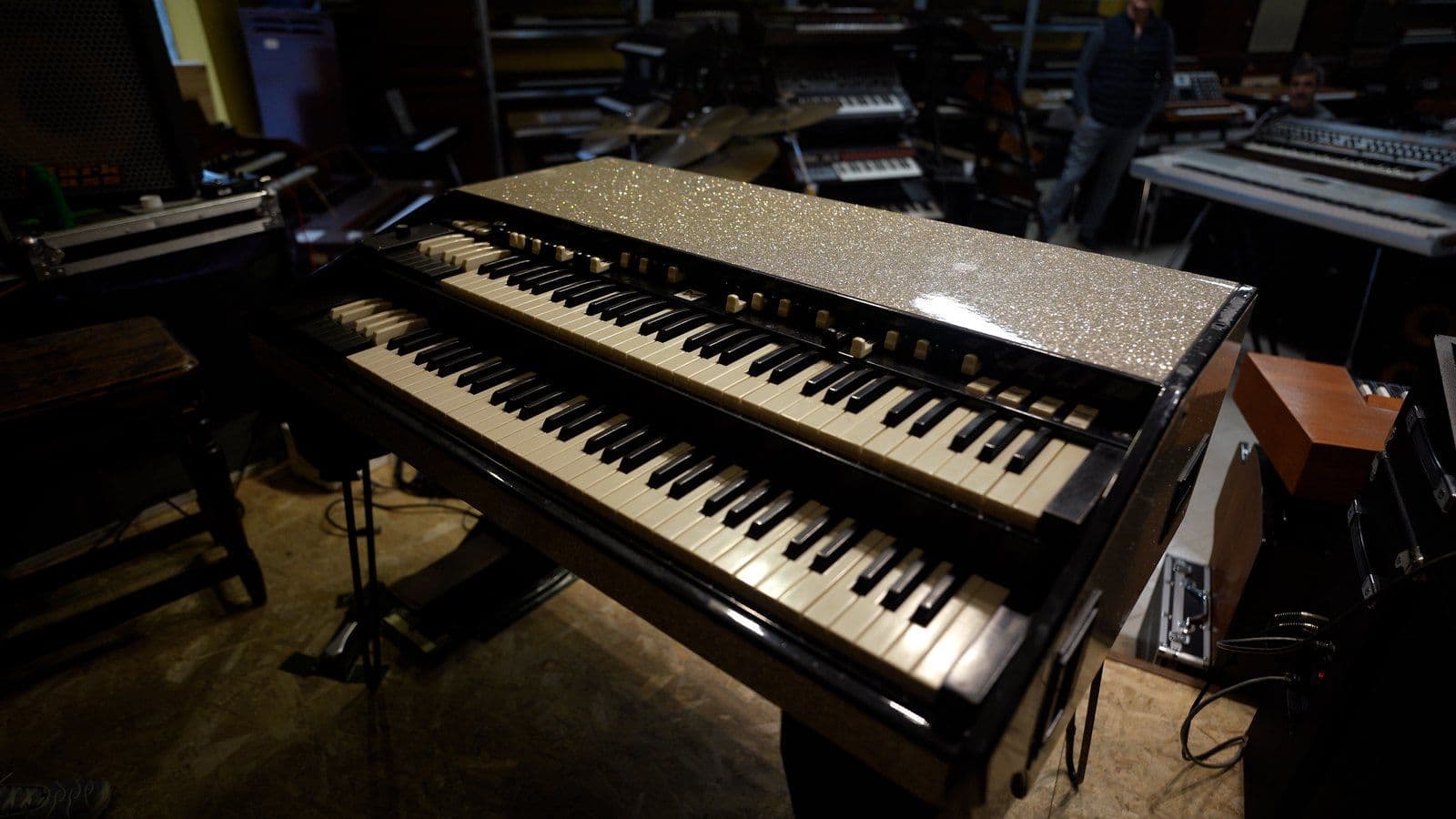
It started life as a 1956 Hammond C3, an American instrument. Then a man in St Petersburg, Florida, who ran a company called Keyboard Specialties, rebuilt it into what he called a stealth organ — the whole thing built down into a portable flight case. Originally it was flat black, which is where the name came from.
He built a few of them. This one he kept, because he liked how it sounded. And that's the part that matters: whoever tuned the tone wheels on this particular organ left an extra harmonic in it. Different eras of Hammond had different people doing the tone wheel tuning, and every so often one of them produced something that simply sings. This is one of those.
Brian played it at a show in Florida, where the man was doing the backline. He told him: if you ever sell this, call me. Years later, in the nineties, the phone rang. He had retired, he wasn't going to play any more, and he was keeping his promise. The organ turned up at the family's place in Venice Beach.
Why it's covered in broken glass
Brian took one look at the flat black finish and decided it wasn't for him.
Karma had been working with Drum Workshop for years, and DW have a sparkle finish they call Broken Glass. Over lunch, John Good at DW made the obvious offer: bring the organ in, and we'll make it beautiful. Six weeks later they went back to collect it, and it came out looking the way it looks today.

So the rarest Hammond on Earth is wearing a drum finish. I love that.
The case that got it down the stairs
When the touring shifted properly to Europe, this was the organ they shipped over, and the reason is entirely practical. It sits in its case in a very specific way, and European venues are small and old and full of stairs. Cellar clubs in Germany. Rooms down a flight of steps inside a museum. You are not walking a standard B-3 into any of those.
The best example Karma gave me: a gig in Lyon, on a ship moored in the river, where the staircase down was exactly as wide as the case standing on its end. One person at the top, one at the bottom, and down it went. As he put it — they're almost certainly the only Hammond that has ever been on that ship.
Fifty cycles, sixty cycles, and one wrong socket
This is the technical detail I keep thinking about.
It's a US organ, so it runs on 110 volts. But there's a second problem that has nothing to do with voltage: America runs at 60 cycles per second and Europe runs at 50. Bring an American tone wheel organ to Europe and it goes flat, because the motor turns at the wrong speed. So the rig carries a unit that converts the mains from 50 cycles to 60, and only then is the organ in tune.
At the start of one tour, the organ went into the wrong socket on that power supply — 220 volts instead of 110 — and it blew the circuit inside. Dead organ, tour starting.
Phone calls were made, and an Italian engineer turned up, rescued them, and fitted the replacement unit that is still in there to this day. His name was Renato Lombardi, and he'd been in Brian's life for a long time already.
The man who sold the same fix three times in one night
Because years earlier, Brian was playing a club in Italy and nobody came.
A man in the audience — Lombardi — told him he could fix his whole sound. At the time Brian was taking a direct out from the organ, but the signal was far too hot; what it needed was a resistor to bring it down to something like a quarter of its level.
So Lombardi took all of Brian's equipment away, fitted the resistor, brought it back, and threw in two full stacks of PA. Brian played, heard it, and said: that's my sound. There it is. He asked how much he owed.
Nothing, said Lombardi. Keep it.
Brian pushed — you've given me more than double what I had, let me pay you. And the answer came back: there were three other organ players in tonight. I already sold this three times.
He built Brian's amplifier, too. He is a large part of why Brian Auger sounds like Brian Auger.
Why it had to be Italy
The organ has a new home now, and the decision behind that is the real ending.
It didn't come out of nowhere. Keki and I had already made a video together at his place, and somewhere in the middle of it the two of us sat down and jammed over Brian's own version of Listen Here. Brian saw it. On 16 July 2025 he posted a clip of it on his Instagram, and wrote this:
I'm totally blown away by this! Two of my favourite Italians, namely Claudio Passavanti aka Doctor Mix and Francesco “Keki” Andrei — owner of Organ Studio Italia, the world's greatest organ and keyboard cave — did me the honour of jamming together over my version of ‘Listen Here’.
He tagged Greg Boraman in it too, which turns out to matter — because Greg is the reason the rest of this happened.

There was another option on the table for the organ: a keyboard museum in Austria. It was turned down, and Karma's reasoning was simple — the family has no deep connection to Austria. Italy has been the connection all along.
What actually made it happen was one email. Greg Boraman — a London institution, a former BBC broadcaster, a man who has worked with some of the great jazz and soul labels — had been talking to both sides. He wrote to Keki, copied Karma in, and said the three of them should talk. Keki rang. Inside five minutes it was settled. Everyone already knew it was right.
And the condition was never put it in a glass box. It was the opposite. It had to go somewhere the love of Hammond already lives, where players can come and see it, hear it, touch it, play it. Keki's place — Organ Studio Italia, seven hundred square metres in Tuscany holding somewhere around two hundred Hammonds, a hundred and forty Leslies and more than two hundred vintage synths and electric pianos, Keith Emerson's cabinet and Jimmy Smith's own B-3 among them — is exactly that.

As Karma said: it has a spirit in it, and everybody should be able to enjoy it.
Where to start with Brian Auger
If this is your first proper encounter with him, don't leave it there. Two starting points came up at the end of the film:
- Live Oblivion, Volumes One and Two — Karma's answer
- Closer To It! — Keki's answer
And that's the story. A man chased an unreasonable dream from the age of ten, paid for it in school books and a hiding, and ended up as the custodian of the instrument that made him.
Go and listen to the music that started it.
From the Doctor Mix shop