The Man Who Ran the Fairlight's Software: Paul Schlusser on the Series III, CAPS and Freshwater
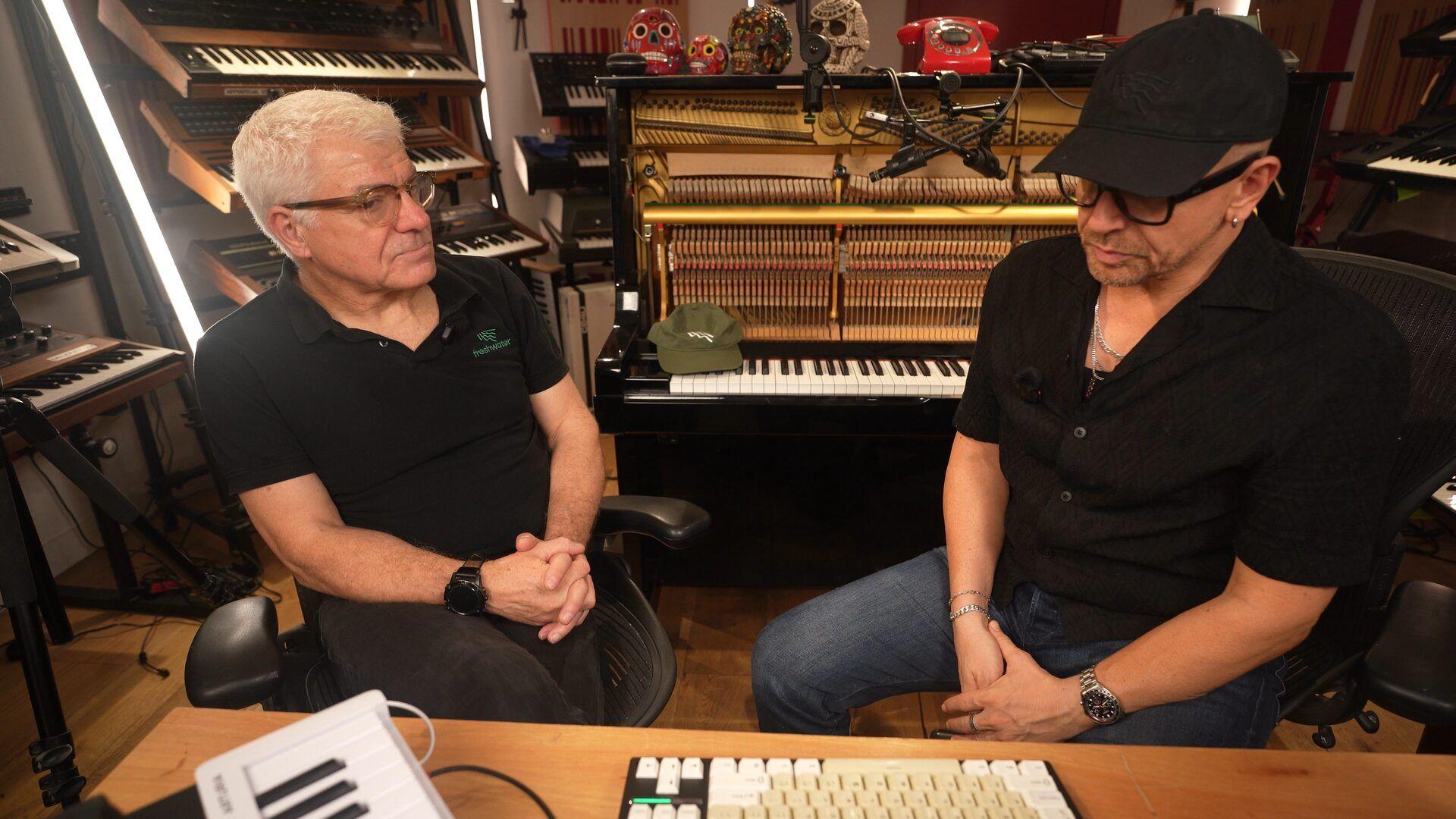
Part two of the Doctor Mix mini-series on the Fairlight CMI. This time: Paul Schlusser, who ran the software team on the Series III and now runs Freshwater Instruments.
In part one, Cris Blyth walked us through the Fairlight from the outside: what it was, who made records on it, why it cost what it cost. This time I wanted the view from inside the building.
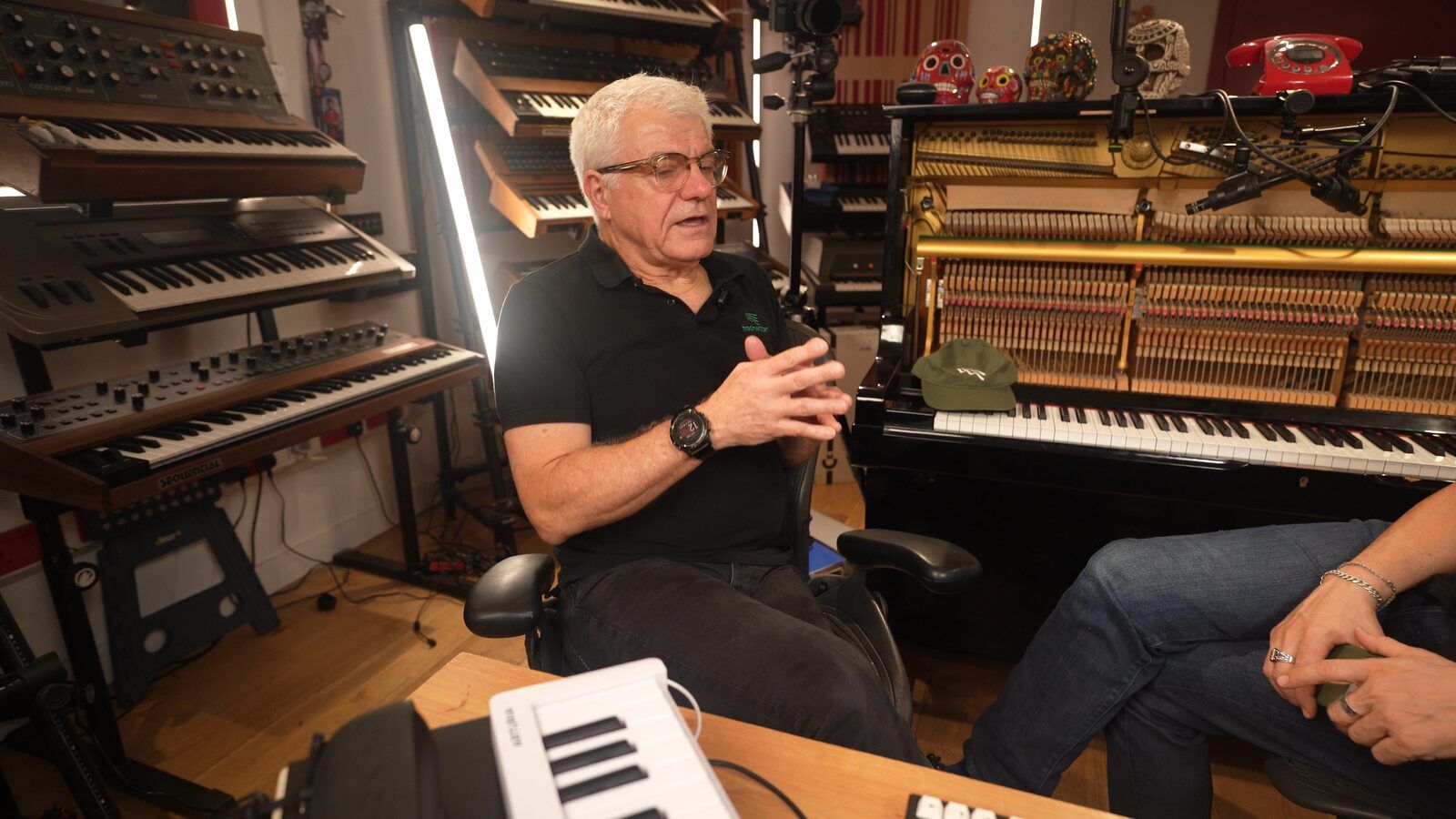
Paul Schlusser landed in London from Sydney at seven in the morning and was sitting in my studio a few hours later. He joined Fairlight in 1984, became software manager on the Series III at twenty-five, and stayed until 1990, when the original company went broke. Today he runs Freshwater Instruments, the company whose archive every scan in this series comes from, and he is writing a book about all of it.
He also brought a folder. I asked him to squeeze out every story the internet doesn't have, and he did.
From electron microscopes to a newspaper ad
Paul studied physics at the University of New South Wales, and Fairlight was already a legend in the student common room: a magical machine being built somewhere in Sydney. Most of his friends didn't care that it made music. They cared that it was a serious computer that ran several programming languages, and that it was the place everyone wanted to work.
His first job was on electron microscopes and liquid chromatography equipment. Then he answered a small classified advertisement in the newspaper and turned up for an interview with Peter Vogel.
Peter and Kim Ryrie were the two founders. Kim handled marketing and promotion; Peter was the hardware and software side. Paul is careful to be fair here: Peter wrote the velocity sensing for the music keyboard and the floppy disk controller, but most of the CMI's application software was written by other people.
Fourteen CPUs and fourteen megabytes
On his first day, Paul was handed a Series III with 14 megabytes of waveform memory and a 380 MB hard drive. For context, an IBM PC at the time came with maybe 256K of memory and an optional 20 MB drive.
It also had fourteen CPUs. Eight of them sat on the channel cards, one per voice card, which is exactly what Cris showed us when he pulled a card out in part one. That is a big part of why the machine was so expensive.
The older Series I and II had only two processors. P1 did all the real-time work and drove the channel cards; P2 ran the user interface, the light pen and the graphics. P1 was an 8-bit chip running at 1 MHz and could update real-time effects about every 10 milliseconds. Put a 7 Hz vibrato on a sound and you were getting a staircase, not a sine wave. Good enough, but right at the limit. Giving every channel its own brain on the Series III was about making the instrument far more expressive.
Two stories running in parallel
Paul says the birth of the Fairlight was "all of the above": an experiment, a business and a solution to a problem, and a story long enough to fill the book he is writing.
In the mid-seventies, Kim rang Peter and asked if he wanted to build the world's best synthesizer. Peter, with nothing much else on, said sure. Their first plan was what Peter now calls the computerised 4600: take the ETI 4600, a build-it-yourself analogue synth from Electronics Today International (a magazine owned by Kim's father), and put a microprocessor on it so it would stay in tune and store patches. Kim's own verdict is that if they had gone down that road, they would have ended up with something like a Prophet-5.
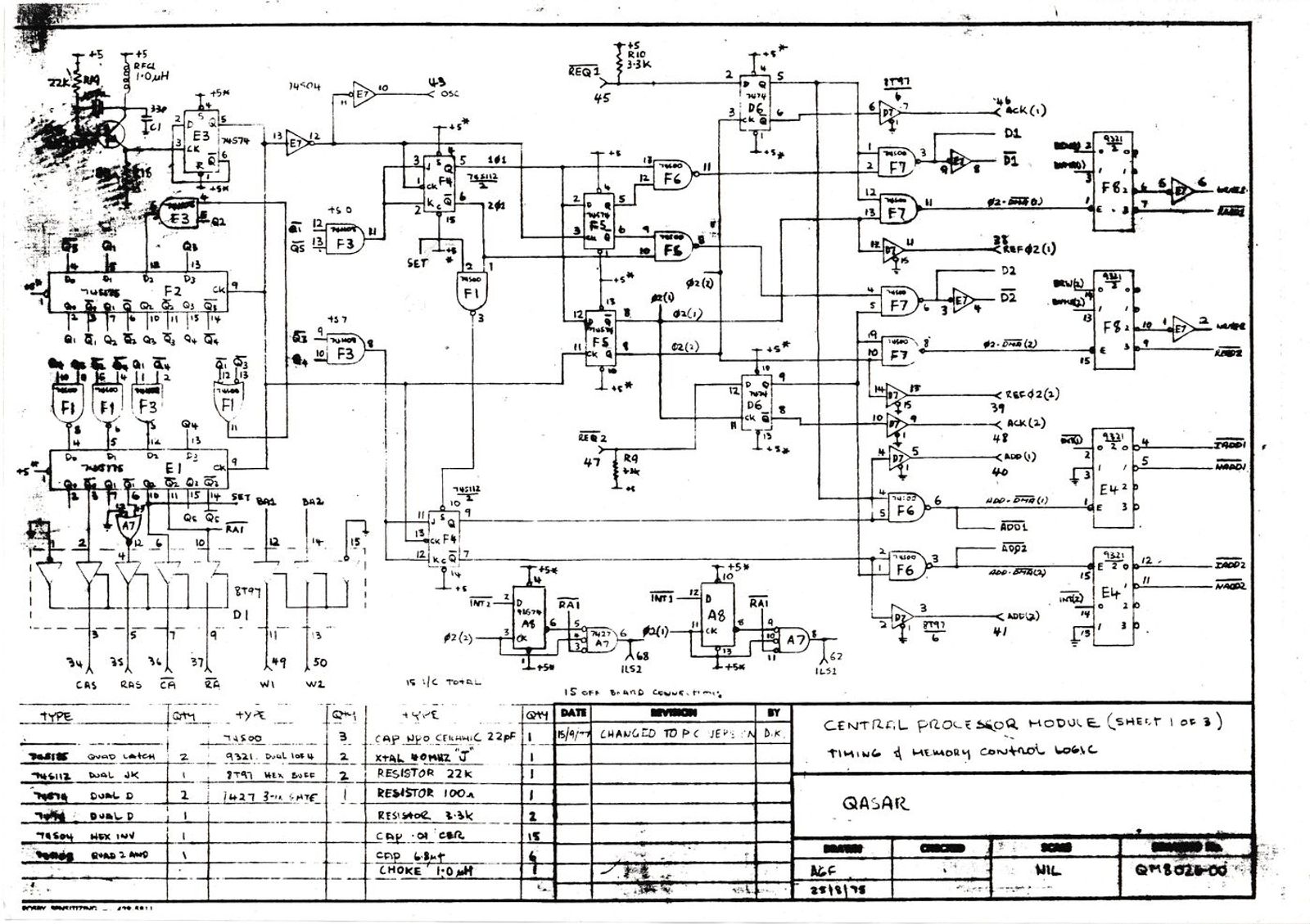
Meanwhile, Tony Furse, a computer engineer doing pre-sales consulting for Motorola in Australia, had already decided that the future of electronic music was digital. From the late sixties to the mid-seventies he built machines called the M1 and M2, and finally the QASAR M8. Around 1975 to 1976 it was a working, fully digital prototype. A single channel had exactly three passive components in its signal path: a tiny filter of a couple of capacitors and an inductor before the output. Everything else was digital.
When Kim and Peter saw it, they realised they were going in the wrong direction. They skipped an entire generation and went all in on digital. Tony's machine was hand-wired, without a single printed circuit board, so their job became turning it into something that could be manufactured.
Before the session ended, Paul pulled out schematics drawn by Tony himself in 1975, barely a year or two after Motorola's 6800 came out. It is already a dual-processor design, the idea that turned into the Fairlight.
Business computers, payroll and car alarms
Along the way, they realised that in 1977 or 1978 they could sell the computer on its own. The QASAR became a business machine with accounting, payroll and stock-control software; the Fairlight factory itself ran on it for years. They sold around a hundred of them to hospitals around Sydney and even to ASIO, Australia's intelligence agency.
Was it a passion project or a business? Paul's answer: passion, with a willingness to do anything that kept it alive. If they had to build business computers to fund the CMI, they built business computers. They made car alarms. Whatever earned a quid.
Hundreds of thousands of lines of assembly
The Series I and II software was written entirely in assembly language. No high-level language at all. Think programming a Commodore 64 in raw machine code, but the whole operating system and every application.
They also wrote the software on the Fairlight itself, on a green screen with 25 lines. When you couldn't hold it all in your head, you printed it on a band printer so loud it needed acoustic hoods, at about two lines a second, and then marked up the fanfold paper by hand.
At its peak, the Series III software team Paul managed was about fifteen people, including two PhDs and several very experienced engineers. He was twenty-five and one of the youngest in the room.
Inventing the toolbar before it had a name
Paul's big push as manager was consistency. Every part of the Series III had been written by a different person: waveform editing, real-time effects, system configuration, the voice library. Each had its own look and feel. His mantra: if it takes six people to write the parts, how is one musician supposed to understand the whole?
So they put icons in a row along the bottom of the screen to match the function keys, and made every page behave the same way, with cut, copy and paste in the same places. Nobody called it user interface design, let alone a toolbar. They had to invent the idea.
Debugging was its own nightmare. With so many processors on a shared bus, when waveform memory got corrupted you didn't know which program had done it, or even which CPU had been running. They hooked logic analysers onto the bus to read the timings.
Eventually they shipped version 5.4, and there was a cake with candles to celebrate. A few months later, reception called Paul down to collect the biggest bunch of flowers he had ever seen. He assumed he'd forgotten his girlfriend's birthday. The card said: "In appreciation for your efforts, Billy Gibbons." He had to ask who that was. He knows now.
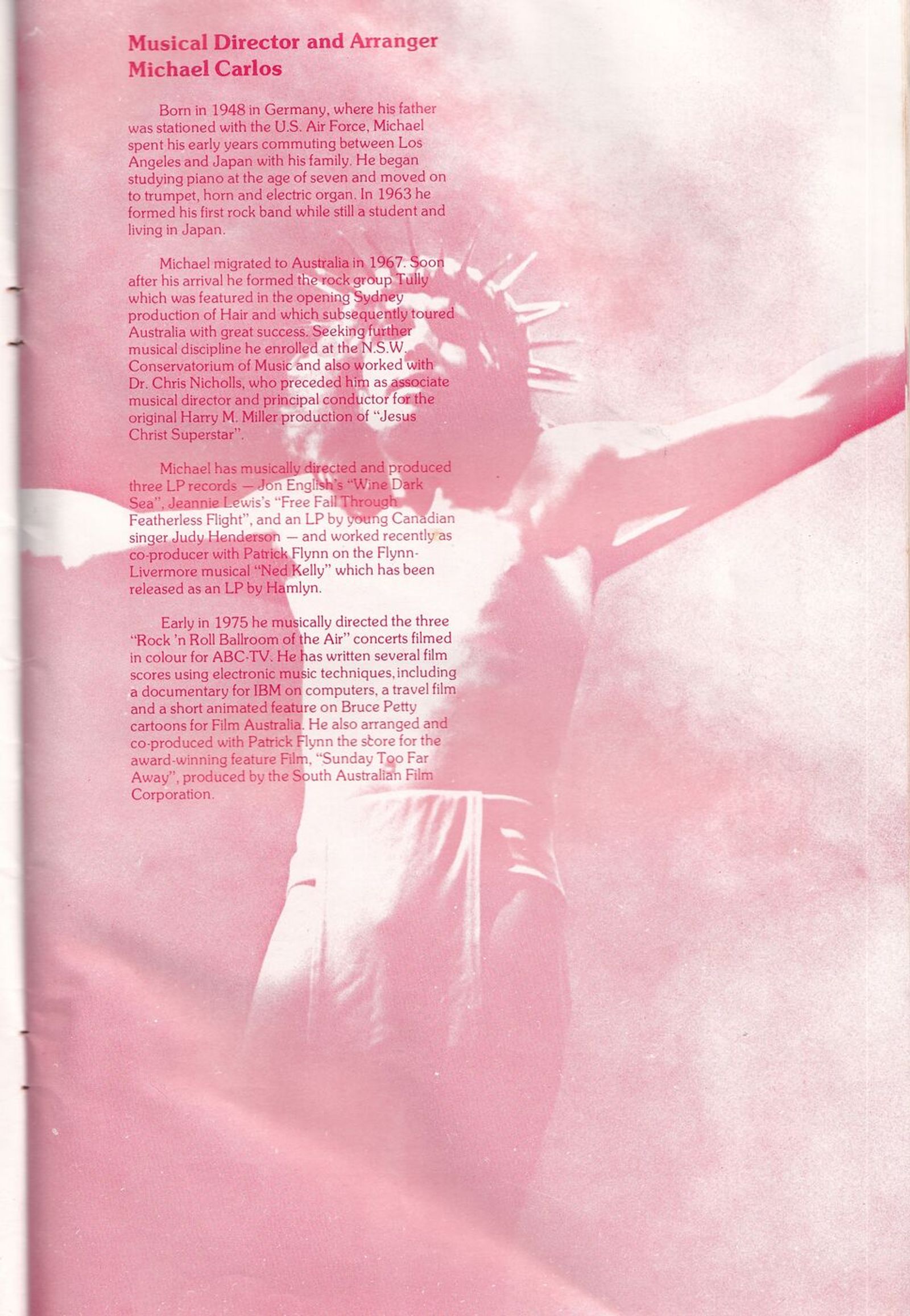
The musician in the room: Michael Carlos
Here is something people don't expect. Paul wasn't a musician when he joined, and the founders weren't really either. Kim doesn't listen to popular music. Peter has said that his interest in hi-fi was the amplifier, and that he watched TV by looking at the tubes glowing in the back of the set.
The musician was Michael Carlos: an established Australian film composer, musical director for Jesus Christ Superstar in Sydney, and a member of the band Tully. He had taught himself assembly language on a Motorola evaluation kit just to generate click tracks for his film cues. Paul says he influenced a huge amount of what the Fairlight became.
Stevie Wonder bought the first one
Kim and Peter were still working out of Kim's grandmother's garage when Bruce Jackson came back to Australia. He had been Elvis Presley's live sound mixer, and after Elvis died he happened to move in next door to the grandmother. She told him he had to see what the kids were doing in the garage. He had a look and said he knew somebody who would be very interested.
That somebody was Stevie Wonder, who bought the first production Fairlight. There is a well-known photo of it front and centre at his Madison Square Garden concert.
"It's fair to say we hated those guys"
Once cheaper samplers arrived, Fairlight went upmarket with the Series III: huge shared memory, multi-sampling, 16-bit sound. Many people still rank it as one of the best-sounding machines ever built. New England Digital saw the writing on the wall and added sampling to the Synclavier, and a fierce rivalry began.
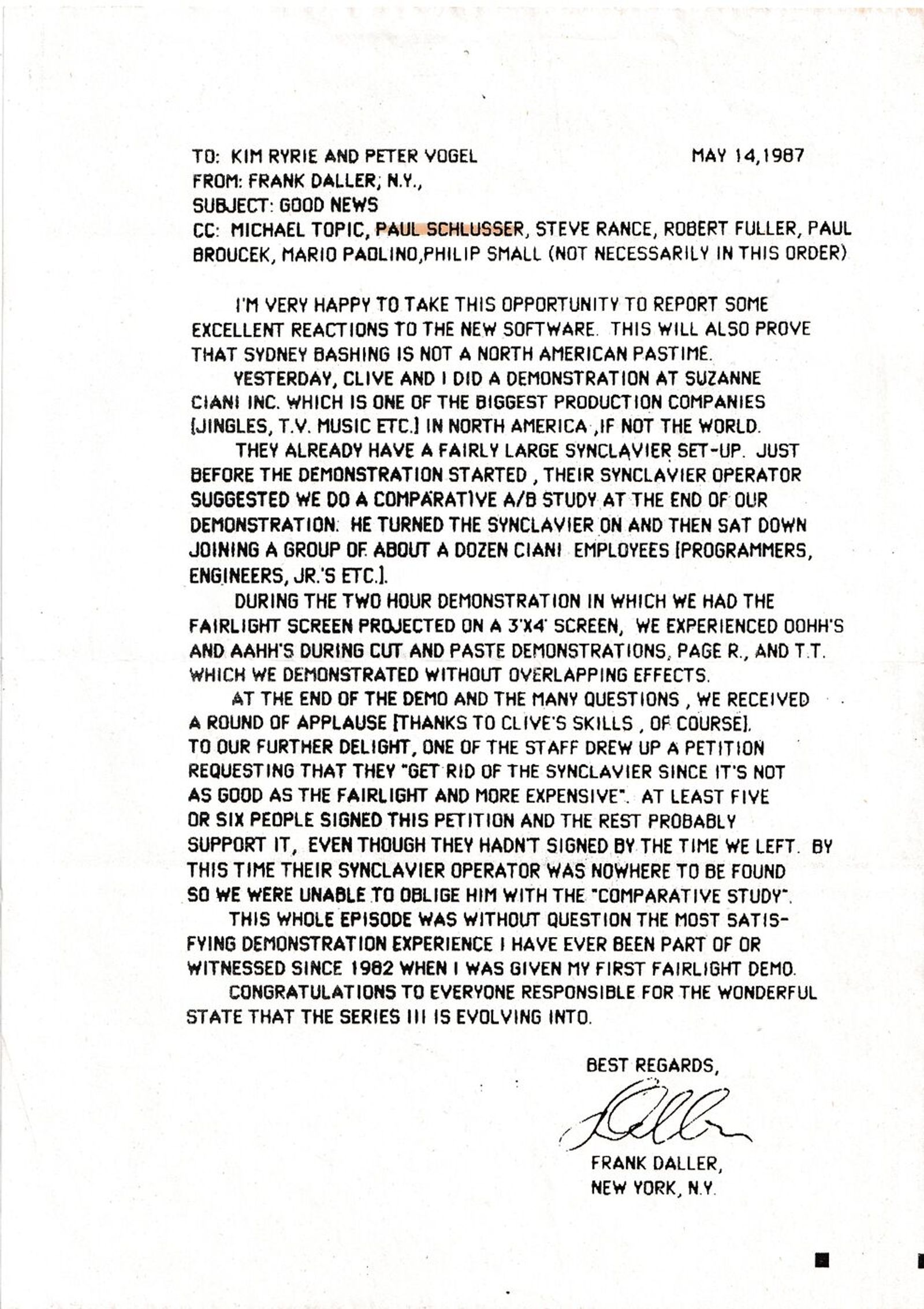
Paul brought proof. On 14 May 1987, Frank Daller in Fairlight's New York office wrote to Kim and Peter about a two-hour Series III demo at Suzanne Ciani's company, one of the biggest jingle houses in North America, which already had a large Synclavier setup. Their Synclavier operator suggested a side-by-side comparison at the end. By the end, staff had drawn up a petition to get rid of the Synclavier because it wasn't as good as the Fairlight and cost more. Five or six people signed it. The Synclavier operator was nowhere to be found.
CAPS: the sequencer that was never going to be finished
I had to ask about CAPS, the Composer, Arranger, Performer Sequencer. Paul's first words: "It was a nightmare."
The Series III launched with RS, the rhythm sequencer: basically a bigger version of the Series II's Page R, with 16 parts, a 96-tick grid and quantised playback. Page R has a cult following and set the template for pattern sequencers ever since. But MIDI had arrived, and people wanted the Fairlight at the centre of the whole studio. Sixteen parts wasn't going to cut it.
CAPS was meant to do everything. When Paul inherited it, it had become an over-specified monster. Work on it for six months and it was nine months away; work another nine and it was twelve months away. In one early concept there wasn't even a record button. The machine was always recording, and you kept the take you liked (Michael Carlos had rightly noticed that the best take is usually the rehearsal you didn't record). A tall order on an 8-bit machine in 1985.
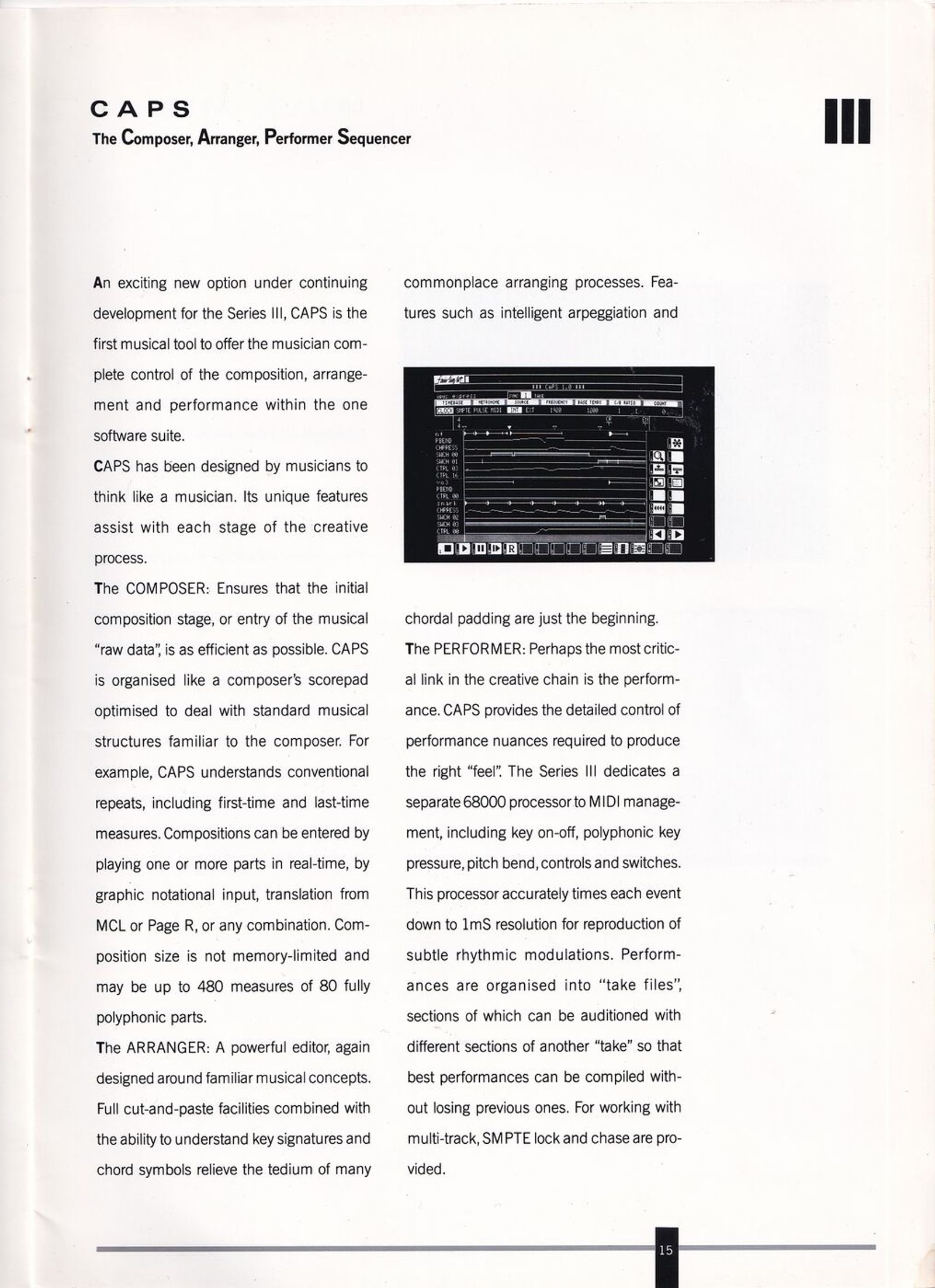
Paul was called into the boardroom for a delivery date and told them it would never be finished as specified. It went down like a lead balloon. His proposal was to throw it away and start again, with real limits:
- 80 parts, not unlimited. Plenty of people argued, but he held the line.
- A fixed block of memory per bar, shared across all 80 parts. You couldn't put hemidemisemiquavers in every part, but real music rarely needs that.
- Undo. Every bar had a shadow copy, so you could take back your last edit. One level only, which was revolutionary at the time.
The Fairlight programmer
This one is personal. I got into sessions as a kid because I could program drum machines, not because I was the best musician in the room. Paul confirmed that "Fairlight programmer" was a real job title in the eighties. You couldn't just wheel one into a studio and play it, and the people who learned them at night became very much in demand.
From a dumpster to Freshwater Instruments
Researching the book, Paul reconnected with old colleagues, met Tony Furse for the first time, and caught up with Chris Alfred, who had stayed with Fairlight for decades. Years earlier, during one of the company's clear-outs, Chris noticed a dumpster that had been rained on for a week and pulled out a pile of 8-inch floppy disks. Among them was what they believe is the only copy of the source code for the Series IIx.
Paul wondered whether that code could run on something much faster. He wrote an interpreter that reads the original 6809 assembly source as text and executes it in real time. Even doing that, a modern computer runs it about ten times faster than the original CPU. And suddenly there was room to do the things the team had wanted to do in 1985 and never could.
Fairlight's name now belongs to Blackmagic Design, so he needed another one. Fairlight is a beach in Sydney's northern beaches, near Manly. Across Manly is Freshwater. Both names were used for Sydney Harbour ferries. So: Freshwater Instruments.
Their first product was a faithful reproduction of the CMI's fragile light pen, made, in Paul's words, at vast financial loss. Their second is the FI50A, a modern quad-core ARM CPU built in the form factor of the original CPU cards. Pull the old cards out, keep the voice and analogue boards, and your CMI is ready for studio work in 2026.
Is there a market for that? "Absolutely not." Only about 300 of the original machines were ever built. His studio manager and his graphic designer are both massive Fairlight nerds who saw a real one for the first time at their job interviews.
What comes next
When Fairlight stopped making instruments, that wasn't the end of what the idea could do. It was just where it happened to stop. Paul's question is what would have happened if they hadn't stopped, and Freshwater is his answer: the machine he couldn't build back then.
A new CMI is on the way. In Paul's words: bigger and better than before. Well, actually, a lot smaller, and lighter. He has promised to come back and show us the prototype, so subscribe to the channel and don't miss it. You can follow Freshwater at freshwaterinstruments.au.
Download the archive
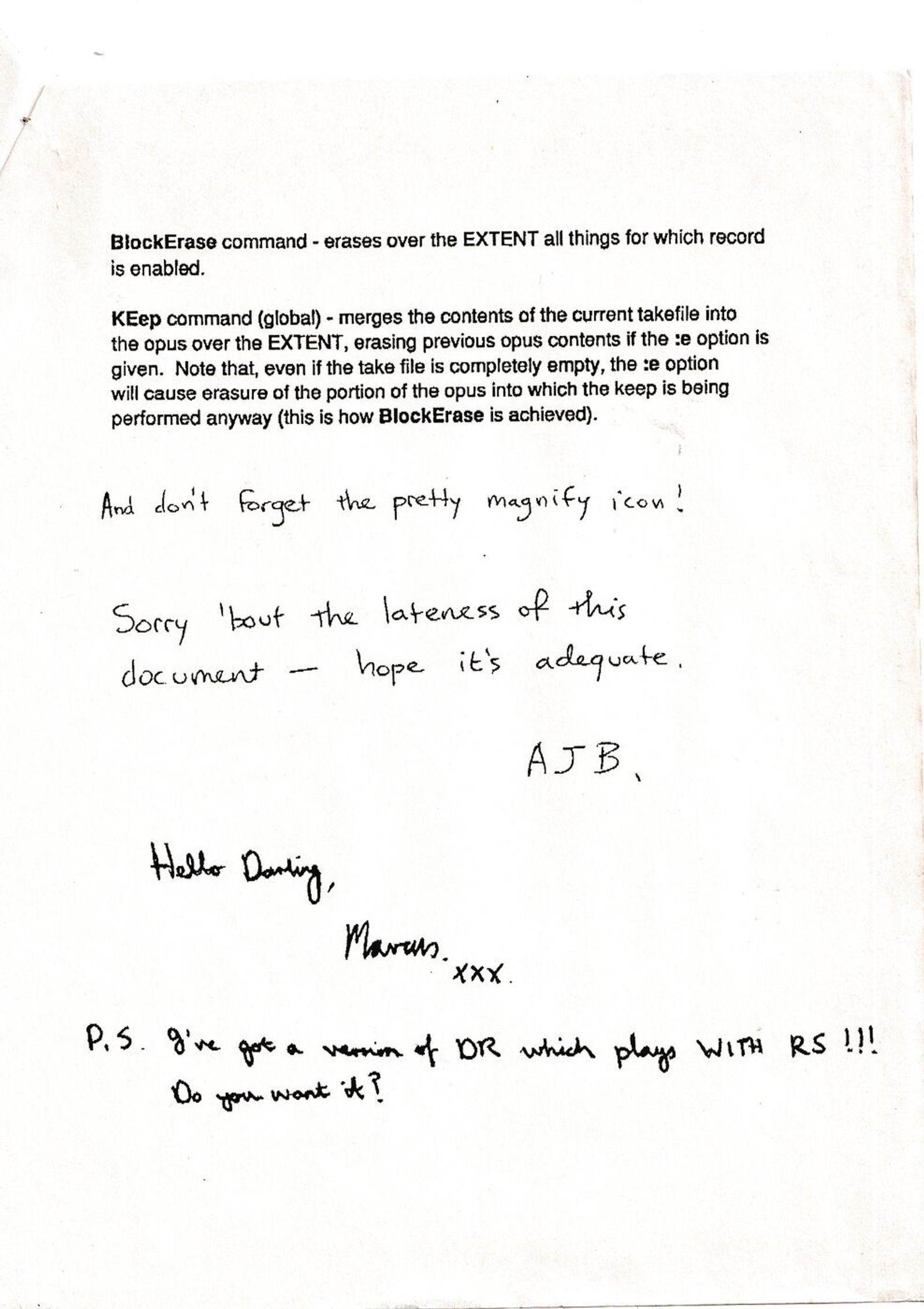
Every document you see in this article is in the Fairlight CMI Archive, alongside everything from part one: 47 files in total, one folder per episode, with nothing watermarked. The new batch includes Fairlight newsletters, Series III brochure pages, CAPS manual pages with handwritten notes, QASAR manuals and schematics, and the 1987 Synclavier letter.
Huge thanks to Paul for flying across the world with a folder full of history, and to Cris Blyth for making the introduction.
— Claudio / Doctor Mix