ASM Leviasynth: A Digital Heart With an Analog Filter
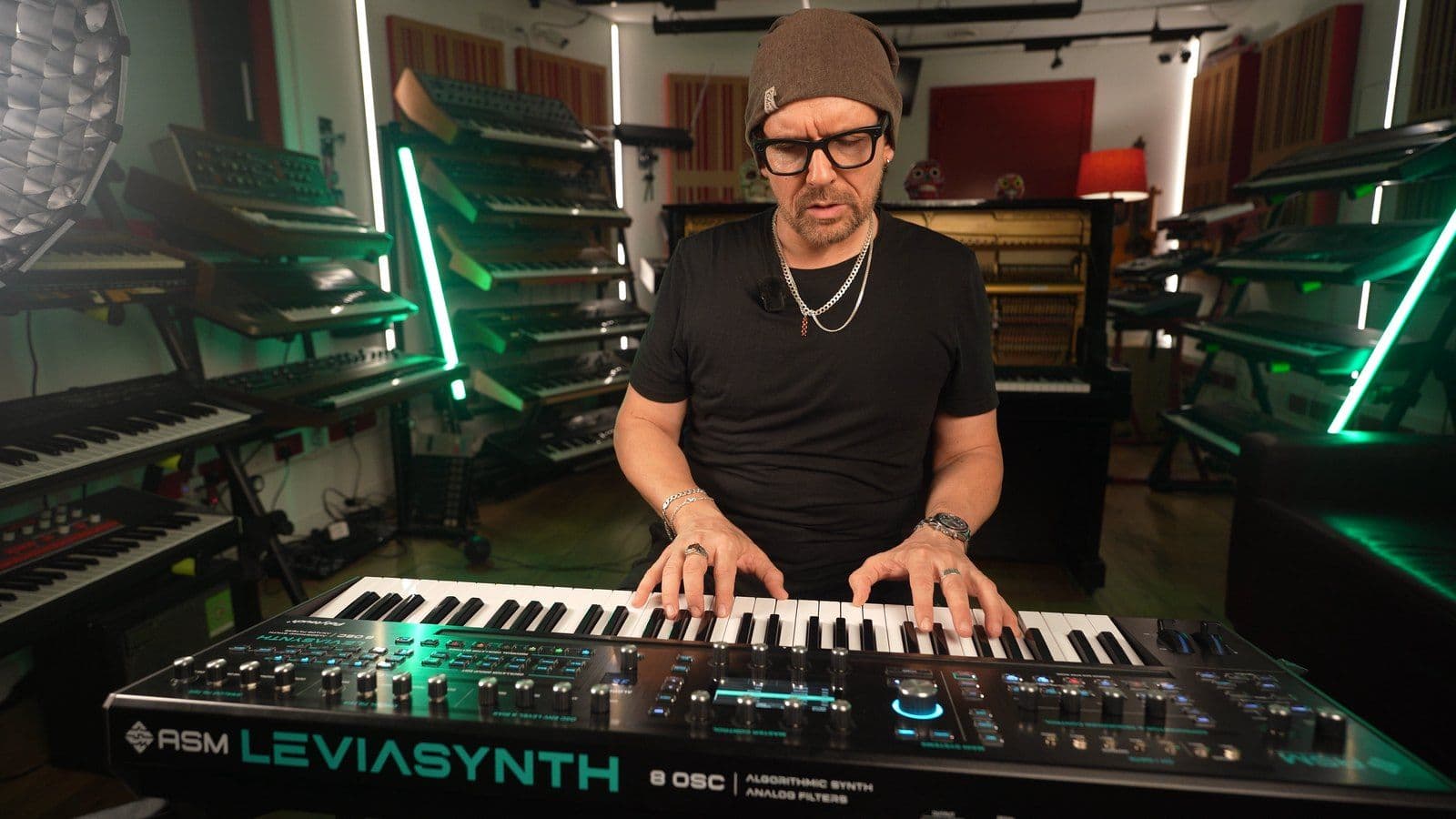
I could not take the smile off my face making this one.
If you know this channel, you know how I feel about the Hydrasynth. It is, for me, the proof that a digital synthesizer can sound genuinely incredible. So when the ASM Leviasynth finally arrived in the studio, I had a fairly good idea of what I was hoping for — and it still managed to surprise me.
Because this one goes further. It has a properly digital heart, an algorithmic engine that runs deep into FM and phase modulation territory, and then a real analog filter on the end of it. There are not many instruments that do both.
First impressions out of the box
It's meaty. You can't fake quality, and you can feel it the moment you lift it out — the weight of it, the stiffness of the hinges, the feel of the keybed before you've even plugged anything in.

Then you switch it on and there's an oscilloscope built into the display. Not a decoration either — it's accurate, and it turns out to be the thing I kept looking at all week, because it shows you exactly what your patch is doing.
Three hundred waveforms and counting
Initialise a sound, go to the oscillator section, and you're straight into around 300 waveforms. Scrolling through them feels like moving through a wavetable — each one shifts the character, and you can watch the shape change on the scope as you go.
You can layer them, balance the level of the second oscillator against the first, detune them against each other. And that is before any of the clever stuff.
The filters are the headline
This is where it earns its money.
Start with the digital filter. Choose a ladder low-pass at 12dB and you get exactly what you'd expect — pull the resonance up and it thins the low end out, and you can see the resonance curve drawn for you on screen. Go to 24dB and it's steeper still.
Then there's fat 12. This is the state-variable behaviour, the kind that doesn't kill the low end. Take the drive off, sweep the resonance up and down, and the bottom simply stays there. It's the difference between a filter that costs you weight and one that doesn't.
There are a lot of these to go through. One of them drives up into unmistakably MS-20 territory. There's a vowel filter that is genuinely special. And all of this is still the digital filter — we haven't touched the analog one yet.
The two-filter trick
Because there are two filters, you can do something I've shown on this channel before: run a high-pass and a low-pass together to carve a moving band out of the sound. Set the high-pass fairly steep, put the low-pass after it, add resonance to taste, and you have that sweeping formant effect that people usually reach for a plugin to get. It's just two filters.
Then take the digital filter out entirely and listen to the analog one on its own. Same patch, same notes. Pull the resonance up on the digital filter and it gets sharp — that hurts, in the way digital resonance can. The analog filter does the same move and it's round.
The filters are also oscillators
They self-oscillate and they track the keyboard.
Which means that if eight oscillators somehow weren't enough for you, you can turn the filters into two more. That's not a spec-sheet line, that's a whole extra instrument hiding inside the one you already bought.

The algorithm matrix
The other side of this synth is the algorithmic engine. You're routing operators through a matrix, which means you can do frequency modulation, phase modulation — and, because simple physical modelling is really just FM used carefully, a bit of that too. I've demonstrated making kick drums this way before; it works beautifully here.

The number of algorithms on offer is, frankly, too many. But the principle stays simple the whole way through: there are two sounds, and the trick is how you modulate one with the other.
Expression
There are instruments you play and instruments that play back. This one has something magic in it — partly the aftertouch, partly the fact that the knobs never step. No zipper noise, no stair-stepping, ever. You move something and the sound moves with you continuously, which is exactly what you want when you're performing rather than programming.
Arpeggiator and sequencer
I initialised everything and started again to show this properly.
Run the sequencer, hit record on track one, and play. Turn the metronome off once you're in. Then the part I like most: entropy. You can randomise the sequence — and rather than randomising the whole thing, you can set the deviation per step. Randomise only the last two steps. Or the last three. Leave the rest locked.

That's the difference between a sequence that falls apart and one that stays yours while still surprising you. Add a delay, sync it to tempo, bring in the other oscillators, and it builds itself.
Worth it?
Thank you to ASM for supporting the channel, and genuinely — go and look at the Leviasynth. A digital instrument with an analog filter, filters that double as oscillators, an FM matrix, an oscilloscope that teaches you what you're doing, and knobs that respond like hardware should.
I'm going to be making more content with this one. It hasn't left the studio and I don't expect it to.
From the Doctor Mix shop