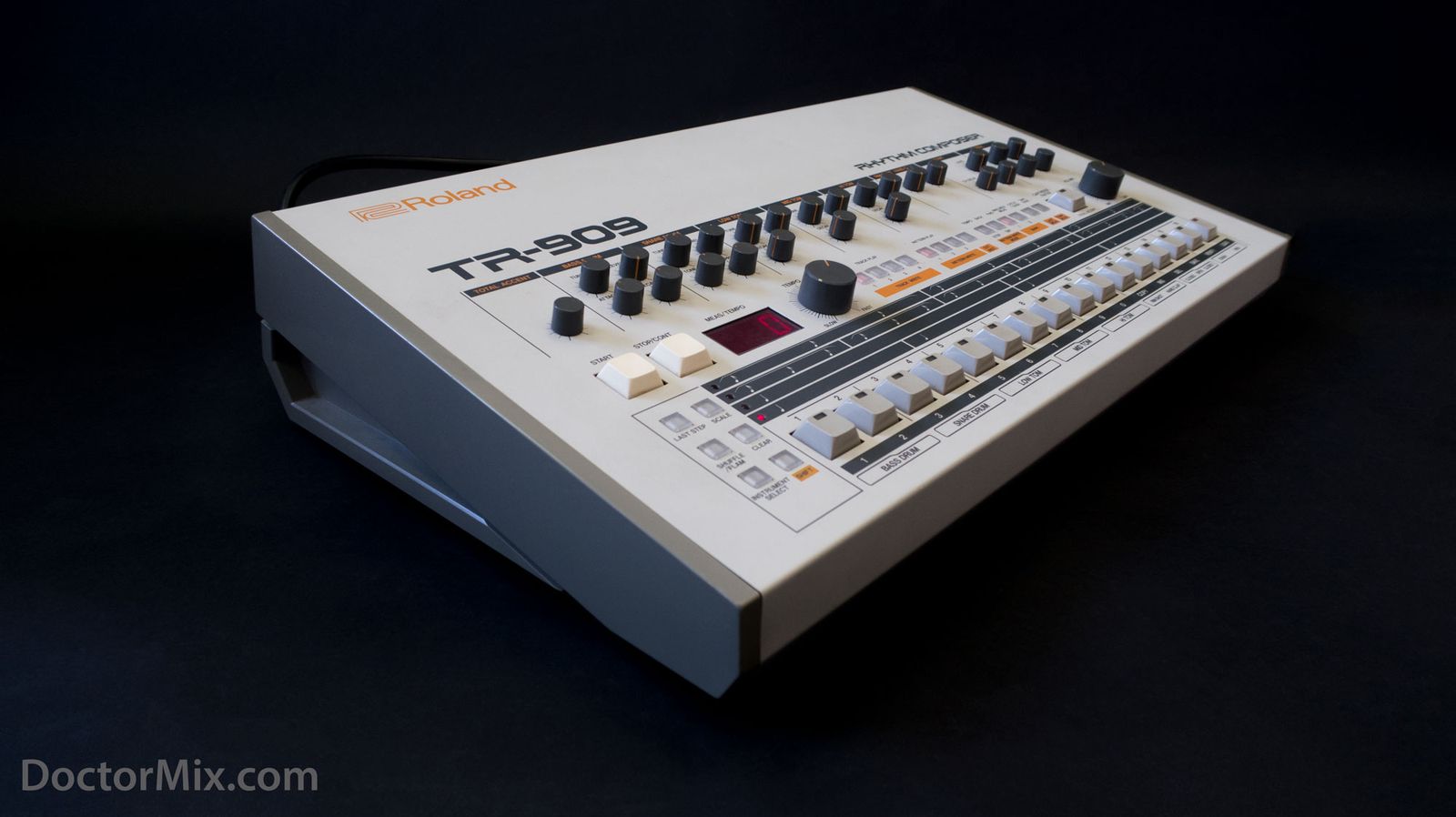
Hear the original Roland TR-909, explore how its patterns work, and download Doctor Mix’s recordings of his own vintage unit in 24-bit, 44.1 kHz WAV format.
Roland introduced the TR-909 Rhythm Composer in 1983. Its combination of analogue drum synthesis, sampled hi-hats and cymbals, and MIDI made it an important part of the sound of house and techno.
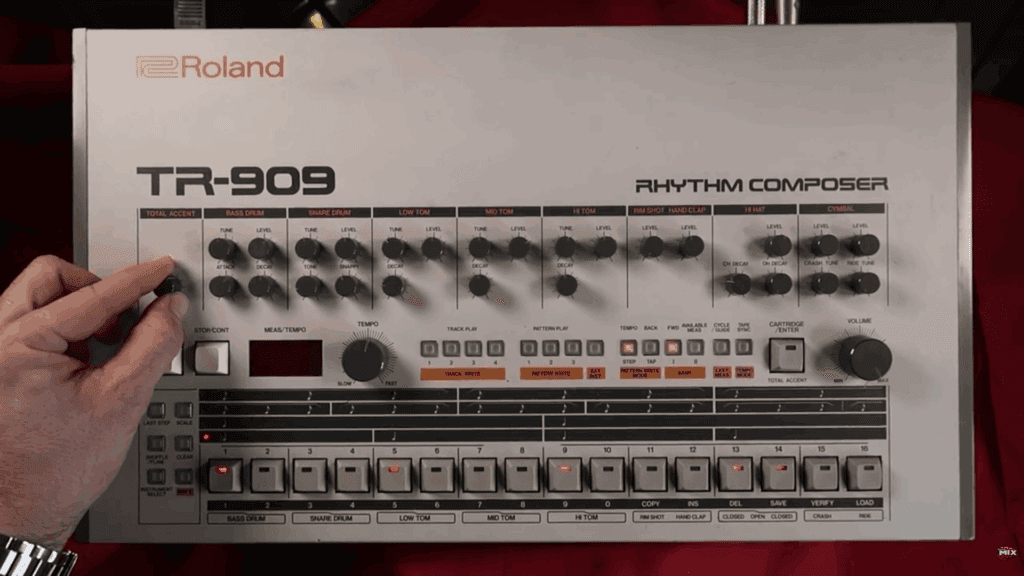
The kick, snare and tom voices use analogue circuitry, while the hi-hats and cymbals use digital samples. Front-panel controls let you shape the sounds, and the step sequencer lets you work directly with rhythm, accents and shuffle.
The 909 also features the “accent” function, where some of the steps in the sequencer can be programmed to make some drum hits sound louder than others. This was designed as an attempt to “humanise” the drum beat. As well as accent on individual drums, the 909 features a “total accent” function that allows all drum sound to sound louder on selected steps, which contributes enormously to the overall feeling of the groove.
As with the 808, the 909 sounded a long way from the more realistic alternatives from Linn and Oberheim that had all but secured the upper ends of the drum machine market. The realism of the TR-909 was limited by technical constraints, and this showed when the machines were released at relatively, low prices before its rise in popularity, coinciding with the beginnings of house and techno. If the 808 was the rhythmic godfather of hip hop music, then the 909 is the same to techno and house music. When techno and house pioneers got their hands on the machine, its analogue sounds – which, in the bass end particularly, provided the relevant thump and the aggressive hats and cymbals added a further idiosyncratic touch to the overall sound of the machine. The inclusion of a flam feature added further to the possibilities. It was, perhaps, the shuffle feature that further defined this as a perfect tool for House. With its roots in R&B, Disco and even Gospel, this rhythmic ‘swing’ was a great fit, and also key to defining the sound of modern dance music. The simple step sequencer was ideal for four-to-the-floor beats, and its abilities to save a number of patterns made the box ideal for full-track studio work as well as live duties.
Try a simple house groove
Start with a kick on each quarter note and a clap or snare on beats two and four. Add an offbeat open hi-hat, then listen to how shorter and longer decays change the space between the hits. Bring in quieter closed hats and vary their velocity before adding more sounds. A small change in accent can do more for the groove than another layer.
A sample captures one performance of the machine. In your DAW, experiment with timing, velocity and different hits; turning up the volume of a single sample does not reproduce every timbral change of the original hardware.
Ready to turn a beat into a complete track? How To Produce House Music includes lessons on building a 909 house beat and working with the 909 in the box.
Doctor Mix’s original TR-909