

The Roland RE-501: A Classic Tape Delay with a Unique Sound
As one of the most distinctive tape delay units ever produced, the Roland RE-501 represents the final evolution of Roland’s electro-mechanical echo machines. With built-in chorus, spring reverb and noise-reduction circuitry, it delivers a deep, lush sound that’s hard to replace once you get used to it.
What Is the RE-501?
The RE-501 is built around a specialised tape loop system designed to create echo and delay effects, supported by a spring reverb and a warm analogue chorus. Audio is recorded onto a moving loop of magnetic tape and then played back through one or more heads before being erased again as the loop completes. Delay time is controlled by varying the tape speed, and the intensity of the repeats is set by adjusting the amount of signal fed back into the loop.
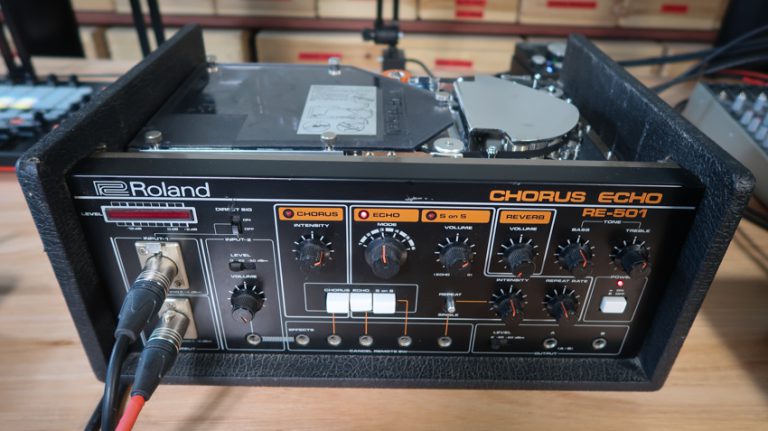
RE-501 with the lid removed, showing the tape tank and transport.
One of Roland’s biggest innovations was the tape tank design. Instead of a cartridge with tape wound around spools, the RE-501 uses a free-running tape loop inside a chamber, guided across the heads by a capstan. This greatly reduces tape wear and lowers wow and flutter, while allowing for longer tape lengths and extended delay times—up to more than three seconds. This approach set Roland echo units apart from many of their contemporaries.
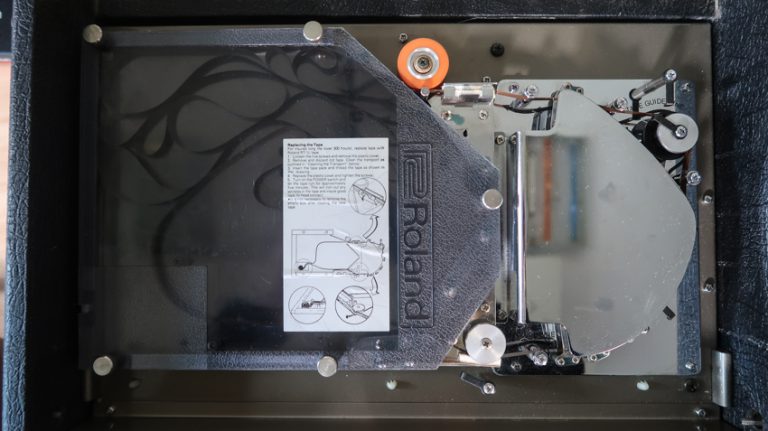
Close-up of the tape tank and the tape path across the heads.
Vintage Echo Machines of the 60s and 70s
During the 1960s and 70s, several tape and magnetic delay units shaped the sound of popular music. The Binson Echorec—with its magnetic drum system—became a favourite of Hank Marvin and David Gilmour. The Dynacord Echocord offered a clean, precise sound, while the WEM Copycat was widely used by working musicians.
Later, the Maestro Echoplex EP-3 gained popularity thanks to artists such as Miles Davis and Don Ellis. The Roland RE-201 Space Echo arrived in 1974 and quickly earned a reputation for being quieter and more versatile, with more complex delay patterns. Its only limitation was the lack of a true Sound-On-Sound function, which Roland soon added in later models.
Roland introduced the RE-301 in 1977, adding a chorus effect, Sound-On-Sound, and dual unbalanced outputs—marking the transition to the “Chorus Echo” line.
The Arrival of the Roland RE-501
Released in 1980, the Roland RE-501 Chorus Echo refined the earlier designs with noise-reduction circuitry, a second mono input, and a pair of balanced XLR connections for professional studio integration.
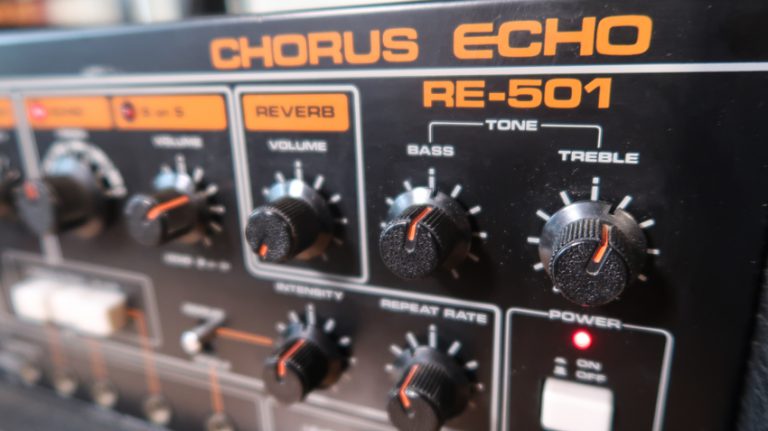
Front-panel controls of the RE-501.
Over the years, various artists have relied on Roland Space Echo and Chorus Echo units, including Lee “Scratch” Perry, King Tubby, Bob Marley, Portishead, Underworld, Tomita, Vangelis, Lauryn Hill and Fatboy Slim.
Controls and Features
The left side of the front panel features balanced XLR input and output connectors (+4 dBm, 600 Ω) offering a mix of the direct and effected signals. There’s also an unbalanced 1/4″ input with adjustable input levels for microphones, guitars or line-level sources.
The built-in chorus includes an Intensity control, and dedicated buttons allow you to choose between Chorus, Echo, or Sound-On-Sound. The Echo Mode selector provides six delay combinations—three single-head modes and three multi-head modes.
A separate level control sets the volume of the echo or Sound-On-Sound signal, and a toggle switch lets you choose between slapback and repeating echoes. When repeat mode is active, the Repeat Rate and Intensity controls shape the timing and number of repeats.
How to replace the RE-501 tape loop.
The Repeat Rate adjusts the tape speed, and changing it during playback produces pitch changes—a musical effect of its own. The Intensity control sets the number of repeats by determining how much of the tape is erased. At maximum, the feedback loop can create self-oscillation. The spring reverb has its own level control, and simple Bass and Treble controls shape the tone of the repeats.
On the lower right, two unbalanced 1/4″ outputs allow for flexible routing. When only Output A is used, it carries a blend of Direct, Echo, Reverb and Chorus. When Output B is also connected, it carries Echo, Chorus and Sound-On-Sound, while Output A carries Direct, Reverb and Chorus—allowing for creative stereo setups. Output levels can be switched between -10, -20 and -35 dB.
Download the RE-501 Manual
You can download the original Roland RE-501 user manual as a PDF here:
https://www.doctormix.com/docs/Roland-RE-501-Chorus-Echo-Manual.pdf
Price Range
Used: £800–£1500